
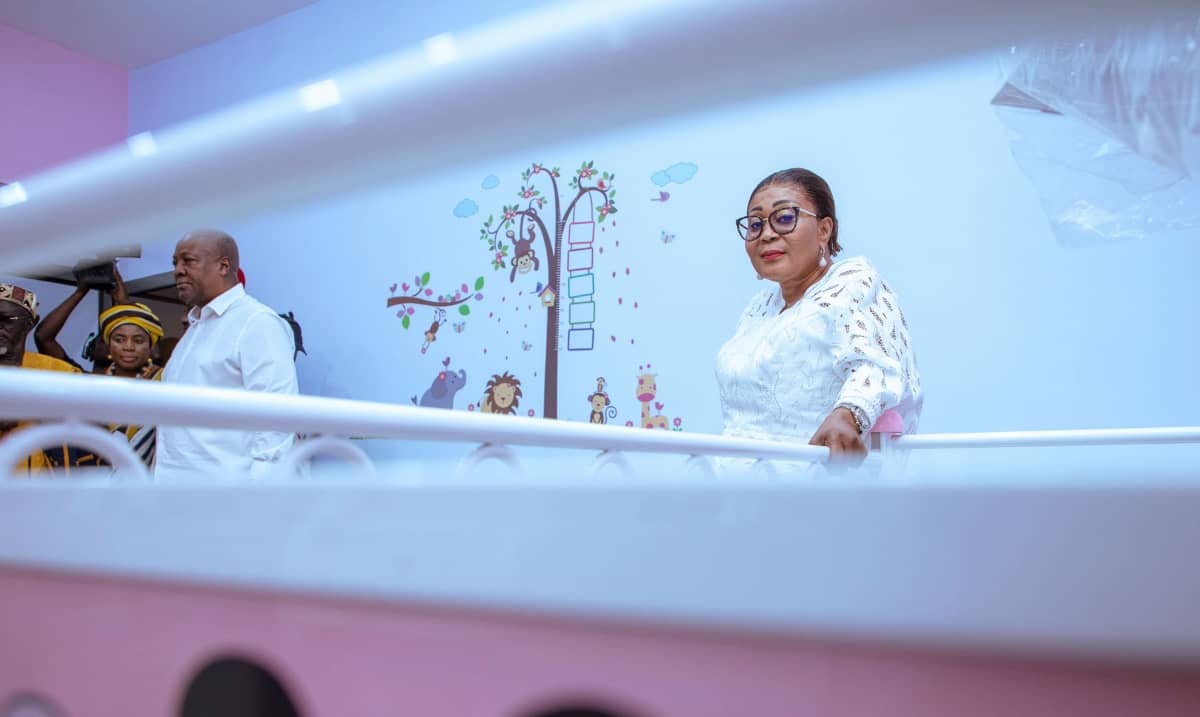
How “The Lordina Foundation” Is Turning Compassion Into Social Infrastructure
By Raymond Awiagah | Behind The Brand Global
In many parts of Ghana, the difference between survival and loss is not always medical.
It is structural.
It is whether a health facility exists within reach. Whether a maternity ward is equipped. Whether a child in a rural community has access to care when it matters most.
In that gap between need and access, social impact work becomes more than charity. It becomes infrastructure.
And over the years, one of the most consistent actors in that space has been the Lordina Foundation, founded by Lordina Dramani Mahama.
But the real story is not about donations.

It is about what happens when compassion is structured into long-term community systems.
When Charity Stops Being Temporary
In development conversations, charity often describes immediate relief, That is food, supplies, or short-term interventions.
But increasingly, across Africa, a different model is emerging.
One that focuses less on visibility and more on continuity.
The Lordina Foundation’s work sits firmly in that shift.
Across Ghana, its footprint is visible in:
- maternity and children’s health facilities
- community health centre upgrades
- scholarships for underprivileged students
- vocational support for young artisans
- targeted support for women and persons with disabilities
- free community health screening programmes
What ties these initiatives together is not scale alone, but structure.
They are designed to last beyond the moment of donation.
Healthcare as a Measure of National Dignity
Few areas reveal inequality more clearly than healthcare access.
In many communities, maternal care is still defined by distance, delay, and limited facilities. And in those moments, outcomes often depend on infrastructure rather than intention.

This is why healthcare-focused interventions carry deeper meaning.
Projects such as:
- the Nkoranza Maternity and Children’s Ward
- the Bole Maternity and Children’s Ward
- the Bodom CHPS maternity facility
- and the rehabilitation of the Anyima Health Centre
represent more than construction.
They represent access points in a system where access determines life outcomes.
The Nkoranza facility, for example, includes a surgical theatre, delivery unit, and neonatal intensive care services, positioning it not as a symbolic project, but a functional healthcare asset for the region.
In communities like Bole, a 45-bed maternity and children’s ward becomes more than a building. It becomes the difference between uncertainty and care for entire families.
The Shift From Aid to Infrastructure Thinking
One of the quiet but important shifts happening in development work today is this:
Impact is no longer measured only by what is given.
It is measured by what continues.
This is where the Lordina Foundation’s approach becomes significant in a broader national context.

Instead of fragmented support, many of its interventions are aligned with long-term systems:
- healthcare capacity building
- maternal care support structures
- education access through scholarships
- skills development pathways for youth and artisans
This positions the Foundation within a growing global conversation around sustainable social investment.
Not just helping communities. But strengthening them.
Women, Children, and the Core of Social Stability
Across development research, one pattern is consistent:
When women and children are supported, communities become more stable.
That principle is reflected strongly in the Foundation’s focus areas.
Maternal health, child welfare, education support, and women empowerment initiatives form the backbone of its interventions.
But the deeper impact is often less visible.
It appears in:
- safer childbirth outcomes
- improved school participation
- stronger household stability
- and increased access to opportunity for vulnerable families
These outcomes do not always make headlines.
But they shape long-term social progress.
Leadership That Works Through Systems
The leadership behind social impact institutions is often judged by visibility.

But increasingly, the more important measure is sustainability.
Under the stewardship of Lordina Dramani Mahama, the Foundation reflects a model of engagement that focuses on continuity rather than publicity.
That distinction matters.
Because in social development, the most important question is not how many projects are launched.
It is how many continue functioning years later.
A Shift in How Impact Is Understood
Across Ghana’s development landscape, conversations are slowly changing.
The definition of impact is becoming more grounded in lived reality:
- Can a mother access care in time?
- Can a child receive treatment without delay?
- Can vulnerable families find support within reach?
These are not abstract questions.
They are everyday realities shaping how communities experience development.
And institutions working at that level are increasingly being viewed not just as charitable actors but as part of the country’s social infrastructure.
Final Thoughts: When Impact Becomes Infrastructure
The most effective form of social intervention is often the one that no longer needs explanation.
It simply works in the background of people’s lives.

Across several communities in Ghana, the Lordina Foundation’s interventions are gradually becoming part of that background, present in healthcare access, education opportunities, and community support systems.
Not as isolated acts of charity.
But as part of a broader structure of care.
Because in the end, the real measure of social impact is not how visible it is.
It is how deeply it becomes part of everyday life.
And in that sense, the conversation is no longer just about philanthropy.
It is about how societies are built.