
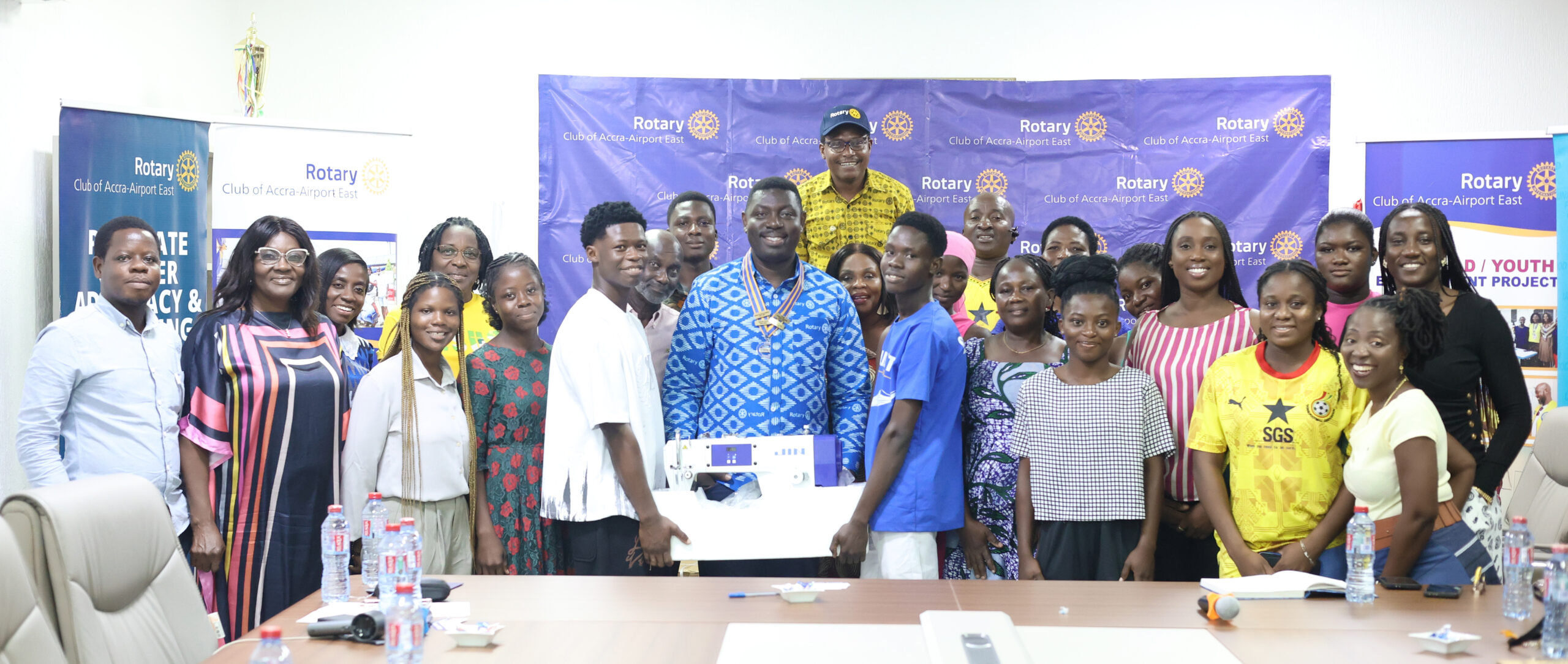
Rotary Club of Accra – Airport East Supports Youth Employment
By Raymond Awiagah
Theme: Growing local economies – Building entrepreneurs
The Rotary Club of Accra – Airport East has held a youth empowerment programme under the theme “Growing local economies – Building Entrepreneurs”, as part of efforts to tackle youth unemployment in Ghana through Technical and Vocational Education and Training (TVET).
Rotary Club of Accra – Airport East: About 20 young people benefited so far
The Rotary Club of Accra – Airport East is deepening efforts to tackle youth unemployment in Ghana by equipping young people with industrial start-up machines under its Youth Empowerment Project.

The initiative has so far benefited about 20 young people and is designed to help them move from training into self-employment.
The latest phase saw five young beneficiaries, aged between 20 and 22 and all focused on fashion design, receive industrial machines to start their own work after completing technical training.
From girl-child focus to wider youth empowerment strategy
Speaking at the presentation, the President of the Rotary Club of Accra – Airport East, Rotarian Benjamin Kofi Baafi said the project originally started as a girl-child empowerment initiative but was later expanded after recognising the wider needs of young people.
“We started this project focusing on the girl child, but along the way we realised that many more young people needed support, so we opened it up to include both young men and women,” he said.

He explained that the main challenge is not only training, but helping young people transition into work after school.
“The problem is not just skills training. The real challenge is what happens after training. Many young people are ready to work, but they don’t have the tools to start,” he said.
Bridging the gap between training and employment
The Rotary President said the project was designed specifically to close that gap between training and employment.
“We realised that if you train someone and send them home without tools, then the training is incomplete. That is why we decided to step in and provide start-up equipment,” he said.
He added that the programme is deliberately structured to ensure practical exposure before beneficiaries receive support.
“We don’t just give machines. We first place them with professionals so they learn on the job, and then we assess them before giving them support,” he explained.
Training, assessment, and start-up support model
Beneficiaries are first placed with partner institutions such as fashion houses and construction firms for practical training.
In this cohort, all five beneficiaries are pursuing fashion design, reflecting the growing interest among young people in creative and vocational skills.

After their attachment, they are jointly assessed by the institutions and Rotary officials before receiving equipment to begin their own businesses.
The Rotary President said the impact is already visible.
“Some of the young people we supported earlier are now on their own. Some of them even produce clothes that we as a club proudly wear,” he said.
“When you see them standing on their own and supporting themselves, that is the real success for us as a club,” he added.
TVET is key to national development – Teshie Technical Institute
The Administrator of the Teshie Technical Training Institute Madam Comfort Mawusi Tetteh strongly endorsed the initiative, describing TVET as a critical foundation for national development.
“TVET is the way to go as a country. It is skills that will build a nation,” she said.
She noted that many developing economies succeed because they prioritise practical skills over dependence on imports.
“We continue to buy from outside, especially from China, but it is skills that will build a nation,” she added.

She explained that even after training, lack of tools often prevents students from practising their trade.
“When students finish training and go home without tools, how do they practise? That is the gap philanthropists like Rotary are helping to close,” she said.
“This machine is my starting point” – beneficiary
A beneficiary Miss Theresa Agbeko Tetteh described the support as a turning point in her life.

“This machine is not just equipment. It is my starting point. Without it, I would still be waiting for someone to employ me,” she said.
Call for stronger support for TVET in Ghana
The Teshie Institute Administrator Madam Comfort Mawusi Tetteh called for increased support for technical education from both public and private stakeholders.
“Government cannot do it alone. We are calling on philanthropists to support TVET so that learners will become self-reliant and not a burden on society,” she said.
She also urged parents to support their children in technical education, stressing that practical training requires both institutional and home support.
Rotary’s long-term vision for skills and jobs
The Rotary Club of Accra – Airport East says the Youth Empowerment Project is part of its five-year strategic plan aimed at reducing unemployment and promoting entrepreneurship among young people.
The club says its focus is not only on training but on ensuring that skills translate into real economic independence.
“Our goal is simple. We want young people to move from training to income-generating work. That is where real empowerment happens,” the President said.

With about 20 beneficiaries already empowered, the initiative continues to demonstrate how targeted support in TVET can move young people from training halls into real economic activity.
For the Rotary Club of Accra – Airport East, empowerment is not a one-time donation, but a long-term investment in people, skills, and sustainable livelihoods.