

Kwesi Botchway and the Power of Reflection at France’s Art Rock Festival
By Raymond Awiagah
Inside the exhibition pavilion of the Musée de Saint-Brieuc, visitors move carefully between mirrors, light, silence, and symbolism. Some pause to observe their own reflections. Others stand still, trying to interpret the emotional weight hidden within the works surrounding them.
At the center of this international artistic conversation is Ghanaian contemporary artist Kwesi Botchway.
Selected to participate in the 2026 Art Rock Festival exhibition themed “De l’autre côté du miroir : Réflexions autour de la réflexion” – translated as “Through the Looking Glass: Reflections on Reflection” – Botchway joins an acclaimed lineup of international artists at one of France’s most thought-provoking contemporary art showcases.
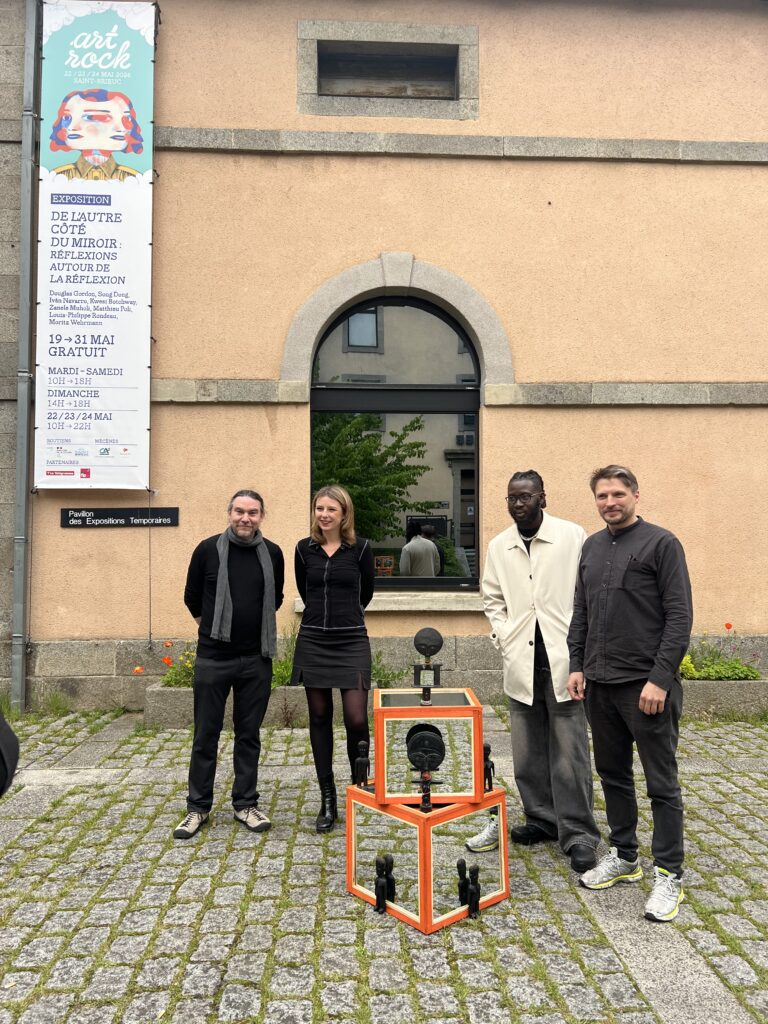
But beyond the prestige of the invitation lies something deeper: a Ghanaian artist bringing African spirituality, ancestral memory, and emotional storytelling into a global cultural space.
A Ghanaian Voice Inside a Global Conversation
The exhibition, running from May 19 to May 31, 2026, explores the mirror not simply as an object of reflection, but as a symbol of illusion, identity, transformation, memory, and perception.
Throughout history, mirrors have fascinated artists, philosophers, and storytellers. Sometimes associated with vanity and self-image, other times viewed as portals to hidden realities, mirrors have long occupied a mysterious place in human imagination.
For Kwesi Botchway, that symbolism takes on a distinctly African dimension.
At the exhibition, he presents his painting “Her Source of Wisdom,” a deeply symbolic work portraying a woman capturing the souls of her ancestors through the image reflected in her mirror. Alongside the painting are several mirror installations touching on themes of rebirth, spirituality, protection, and human connection.
It is the kind of work that does not merely decorate a gallery wall.
It asks questions.
Questions about memory.
Questions about identity.
Questions about the unseen spiritual relationships between the living and those who came before them.
Beyond Aesthetics
What makes Botchway’s participation particularly significant is the emotional language of his work.
While many contemporary artists use mirrors as visual experiments, his approach feels more personal and spiritual. The mirror becomes less about appearance and more about inheritance, a passage between generations, emotions, and histories.

That perspective stands out powerfully within the exhibition’s wider international dialogue featuring globally recognised artists including Douglas Gordon, Song Dong, Iván Navarro, Zanele Muholi, Louis-Philippe Rondeau, Moritz Wehrmann and Matthieu Poli.
Yet even among such celebrated names, Botchway’s work carries a quiet intimacy rooted in African storytelling traditions.
The Rise of Ghanaian Contemporary Art
The growing international recognition of Kwesi Botchway reflects a larger shift taking place within the global art industry. African contemporary art is no longer being viewed as peripheral. It is becoming central to major cultural conversations around identity, history, race, spirituality, and human experience.
Artists from Ghana, in particular, are increasingly commanding attention across galleries, museums, fairs, and residency programs around the world.
But Botchway’s influence extends beyond exhibitions.
As the founder of Worldfaze Arts, an art residency and creative space in Accra, he is also helping nurture the next generation of African creatives by creating environments where experimentation, collaboration, and artistic growth can flourish.
That commitment to building community alongside personal artistic practice is part of what makes his journey compelling.
He is not simply exporting artwork.
He is helping shape creative culture.
Reflection Beyond the Mirror

Perhaps the most striking thing about Botchway’s presence at the Art Rock Festival is how naturally his work fits the exhibition’s philosophical direction.
The mirror, in his hands, becomes more than a reflective surface.
It becomes memory.
It becomes spirit.
It becomes protection.
It becomes ancestry.
And somewhere in Saint-Brieuc, France, audiences are encountering African perspectives not as distant ideas, but as living emotional experiences.
That is the quiet power of art.
And artists like Kwesi Botchway are ensuring that Ghana remains part of that global conversation.