

How Pizzaman Chickenman Is Redefining Fast Food Infrastructure in Ghana
By Raymond Awiagah | Behind The Brand Global
The Pizzaman Chickenman Story in Ghana
In Ghana’s rapidly expanding food industry, the biggest challenge is no longer demand.
It is scale.
How does a local food brand maintain consistency, affordability, and identity while expanding across dozens of locations in a highly competitive market?
For one of Ghana’s most prominent fast-food chains, the answer lies in a model built not from corporate boardrooms, but from a student hostel room in Kumasi.
That brand is Pizzaman Chickenman.
What began as a small student-driven pizza experiment at KNUST has evolved into one of Ghana’s fastest-growing local restaurant systems, now operating across dozens of outlets nationwide.
But beyond food, Pizzaman Chickenman represents something bigger:
The rise of structured youth-led food infrastructure in Ghana.
From Hostel Experiment to National Food Brand
The story begins in 2018 in Kotei, Kumasi, near the Kwame Nkrumah University of Science and Technology (KNUST).
Three students driven by limited resources but strong entrepreneurial ambition began selling pizza slices from a rented apartment.
With minimal equipment and improvised packaging methods, what started as a survival hustle quickly evolved into a growing student food demand.
Early traction came from campus networks, student leaders, and word-of-mouth adoption, proving something important:
There was a demand for accessible, locally built fast food alternatives.
But growth alone was not enough to sustain the idea.
The Turning Point: From Informal Hustle to Structured Business
Like many early-stage startups, Pizzaman faced financial constraints that forced temporary setbacks.
However, instead of collapsing, the business model evolved.
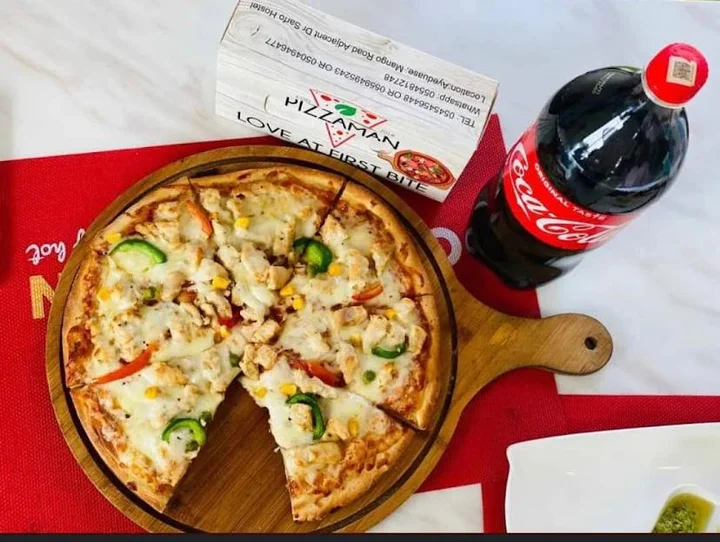
A relocation to Ayeduase marked a key turning point, with the brand recording its first significant monthly revenue milestone, signaling that the concept was commercially viable beyond student demand.
The real transformation, however, came in 2019.
Through a strategic partnership with Quick Angels Ghana Limited, the business expanded into a dual-brand structure:
- Pizzaman – pizza and fast comfort food
- Chickenman – Ghanaian rice meals and chicken-based offerings
This was not just expansion.
It was a market segmentation strategy designed for national scalability.
A Dual-Brand Strategy Built for Scale
The structure of Pizzaman Chickenman reflects a deliberate attempt to serve two major consumer demands:
Pizzaman:
A fusion of American and Italian-style pizza designed for convenience, customization, and youth-driven food culture.
Chickenman:
A locally grounded food experience built around Ghanaian staples such as jollof rice, fried rice, and seasoned chicken prepared with locally inspired spices.
This dual model allowed the brand to bridge two markets:
- global fast-food culture
- local culinary identity
In effect, the company positioned itself at the intersection of tradition and modernity.
Building the Infrastructure Behind Fast Food Expansion
What distinguishes Pizzaman Chickenman from typical fast-food operations is not just product diversity, but operational structure.
The company now operates:
- more than 70 outlets nationwide
- multiple central kitchens and warehouses
- a 24-hour operational delivery system
- drive-through service models
- a centralized call and logistics system
- a workforce of over 1,500 employees
This infrastructure enables consistency across locations, ensuring that food quality and service delivery remain standardized regardless of geography.
In practical terms, Pizzaman Chickenman is not just a restaurant chain.
It is a national food distribution system.
The Logistics Behind Everyday Food Access
At the core of the brand’s expansion is a centralized production model.
Central kitchens supply multiple outlets, allowing for:
- faster preparation times
- improved quality control
- scalable production efficiency
- reduced operational fragmentation
This system mirrors global fast-food logistics models, adapted to local market conditions.
It also reflects a shift in Ghana’s food economy, from small independent eateries to structured, system-driven brands.
Youth Entrepreneurship at Scale
One of the most significant aspects of the Pizzaman Chickenman story is its origin.
Unlike multinational franchises entering Ghana, this brand was built locally by young entrepreneurs.
Its growth reflects:
- rising youth participation in enterprise creation
- increasing acceptance of local fast-food brands
- the role of university ecosystems in entrepreneurship
In many ways, the brand represents a broader shift in Ghana’s economic landscape, where young founders are moving from informal business activity into structured national enterprises.
Cultural and Economic Impact
Beyond commerce, Pizzaman Chickenman has contributed to:
- youth employment generation
- food culture transformation
- local brand competitiveness
- expansion of Ghanaian fast-food identity
Its presence also challenges long-standing assumptions that large-scale fast-food success must come from foreign franchises.
Instead, it demonstrates that local brands can scale nationally while maintaining identity.
The Bigger Insight: Fast Food as Infrastructure
The rise of Pizzaman Chickenman reflects a deeper shift in Ghana’s economy.
Fast food is no longer just about convenience.
It has become:
- a logistics industry
- an employment engine
- a cultural expression
- a structured distribution system
In this context, restaurants are evolving into infrastructure networks that connect production, distribution, and consumption at scale.
Final Reflection
The Pizzaman Chickenman brand today is bigger than a fast-food chain.

It is a practical example in youth entrepreneurship and local brand evolution.
From a student hostel in Kumasi to a nationwide food system, the brand represents a broader transformation in Ghana’s business landscape.
And at the center of that transformation is a simple idea:
Local ambition, when structured correctly, can become national infrastructure.